TreeKeepers provide a solution for healing bark-stripped trees
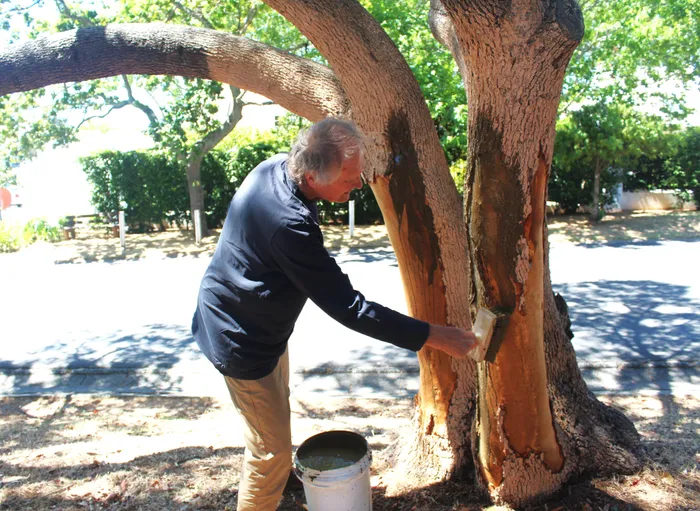
TreeKeepers’ arborist, Riaan Van Zyl applies tree paste on a Camphor tree in Southern Cross Drive, Constantia.
Image: Wesley Ford
The TreeKeepers, a non-profit organisation, has developed an alternative solution to help repair trees damaged by illegal tree bark stripping.
The Kenilworth-based non-profit has been around for 12 years and works to conserve trees in urban areas, providing advocacy and education to help preserve them.
On Wednesday, December 3, TreeKeepers’ arborist, Riaan Van Zyl, conducted a tree paste demonstration on a camphor tree in Southern Cross Drive, Constantia, where tree paste was applied to the affected parts of the tree where the bark had been removed.
Mr Van Zyl said the purpose of the tree paste was to protect and promote the cambium layer of the tree, which is responsible for developing and replacing damaged tree bark.
The inner and outer bark form the tree's vascular system. “It brings the moisture of the leaves down to the roots, and the water from the roots up to the tree,” he said.
Mr Van Zyl makes the tree paste himself, and it is available to his clients and contractors who use it to promote tree vitality and provide protection to trees as needed.
The tree paste is made from sand, clay, and cow manure and is rich in bio-stimulants and plant nutrients.
Mr Van Zyl said that tree paste has been around and used in agriculture for more than 100 years.
The tree paste is not only for trees that have lost bark through bark stripping, but also for trees in a poor condition and poor vitality, according to Mr Van Zyl.
“A layer of tree paste feeds the inner bark and feeds the entire tree,” he said.
Mr Van Zyl said he uses the tree paste for trees that are in trouble. “Trees get into trouble because the urban environment is a difficult place for trees to grow,” he said.
The City’s mayoral committee member for community service and health, Francine Higham, said there has currently been a decline in reported tree stripping cases. “However, from past experiences, reports from tree bark stripping usually increase before the December holiday period,” she said.
The city still uses a paint on tree bark, which Ms Higham said is a low-cost, effective way of reducing the impact of tree bark stripping.
With regards to the paste, Ms Higham said there is no sufficient scientific evidence to support this practice. “However, the department has and will still allow friends groups and individuals to apply tree paste should they deem it necessary,” she said.
The department encourages residents to report bark stripping to the City’s Public Emergency Communication Centre on 021 480 7700.
Mr Van Zyl said any neighbouring communities can contact him via TreeKeepers if they would like tree paste to help heal or vitalise their trees, or directly via WhatsApp on 0769981828 or riaan@treedoc.co.za

From left are representatives of TreeKeepers, Riaan Van Zyl, Tirzah Webb and Angela Wain, along with supporter of organisation, Anthony Wain.
Image: Wesley Ford